
Johnny the Neanderthal is very anxious. He has a date with a cute Homo sapiens he met at the Rocks and Sticks café the other day. He is wearing a freshly skinned deer, has his wolf fang necklace around his neck, and favorite hunting club resting on his shoulder. He is the vibe.
But what time did they agree to meet? Was it when the blue birds start their evening song? Or when the big rock falls under full shadow? And today has been cloudy the whole day!
the beginning of time
Johnny was not the first to deal with these kinds of temporal problems. Time has always played an important role in advancing human societies, whether it was organizing events or structuring everyday life. This is why we have always tried to define and measure time to the best of our abilities at the time.
We began with nature. Early humans used the shadow of the sun and its relative position to a steady landmark to approximate the time. It was a mess. As we know now, the sun’s position on the sky fluctuates due to the rotation of the earth along its axis and around the sun. This led to time periods shifting considerably throughout the year and many friendships ruined over missed plans.
Then came the sundial. The principle was the same, let the sun tell us the approximate time of day. By now, some of the earlier problems had been solved. Affixing the sundial, orienting it properly, and adjusting its height according to the local latitude, made it a much more accurate instrument for telling the time. Bosses were happy. But only on sunny days.

no wasted time
Things started moving fast after that. Ancient Egyptians figured out how to measure time by letting water flow from one container to another. That was not accurate enough for monks in medieval Europe who needed a way to regulate prayer times, so they invented the first types of mechanical clocks. Amen.
Heavy and bulky at the beginning due to using weights and gears, mechanical clocks evolved to compact and portable after the invention of springs. Unfortunately, it was also the period with the most watchmakers being poked in the eye.
finding the time
Although the powering mechanism of clocks all over kept improving, setting the time of the day remained a subjective affair.
Every morning, while out for their daily chores, people looked up at their local tower clock, some at churches while others at city buildings like city halls, and adjusted their watches. That ensured that everyone was on the same schedule and interactions happened on time, as long as all parties involved had adjusted their clocks from the same tower, a somewhat precarious proposition.
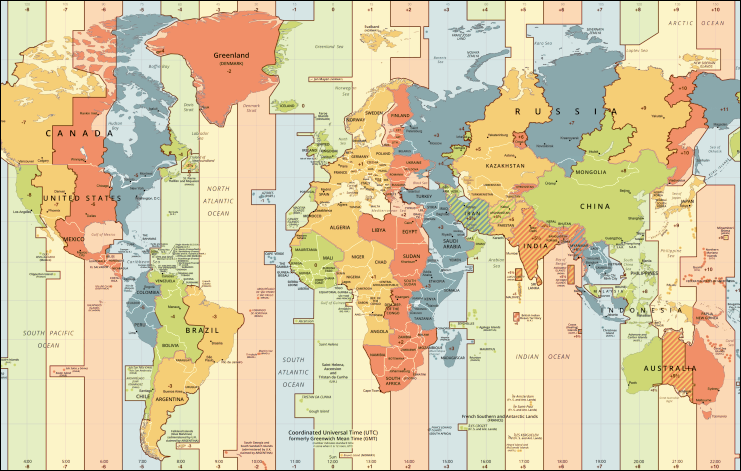
The invention of the telegraph changed all that. Now community clocks could be synced up and the first time zones were established. Even when traveling from one city to another, time remained the same. Once Coordinated Universal Time, known as UTC, was agreed upon, the world started counting the minutes in unison.
a timely solution
Even though we had finally reached a globally accepted time reference, we still had to seek out the nearest time source and adjust our watches often. So, every time a new technology was discovered, we tried to use it to make the current time accessible to everyone easier.
The telephone was somewhat successful. We could call a specific number where a human recording would announce the current time every 10 seconds followed by a beep. That recording was also very soothing to hear and an entire generation was raised by falling asleep to it at night.
Then came the radio. No need to call. Just listen to your favorite program and an appropriate message would notify you of the time on the top of every hour. Radio DJs never again had a more captive audience.
it’s about time
Having access to the exact time at our fingertips was great. But we needed something that would automate that. And radio would come to the rescue once again.
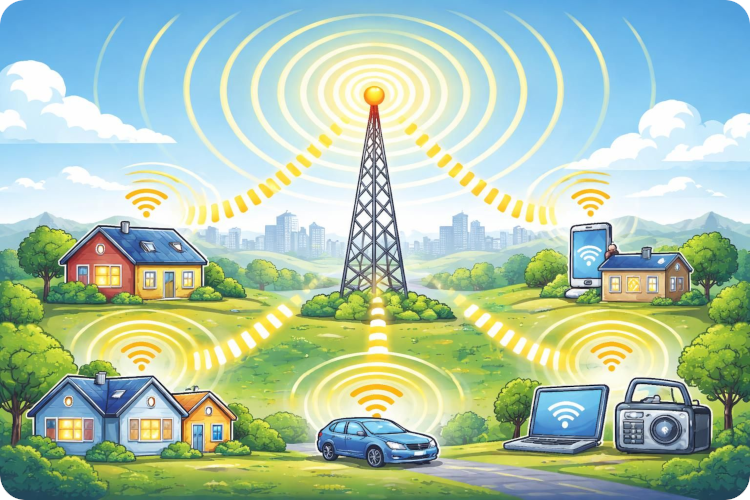
This time it was not by voice though. By now we had figured out how to use the radio waves to transmit the current time in low frequency signals that traveled long distances. In turn, we created clocks that could read those frequencies and adjust the time to be in sync with them automatically. Time no longer required us to work overtime.
time-sensitive information
Nowadays we have over 50 time signal stations broadcasting the current time all over the world. Their operation is not standardized which means that they each operate in different frequencies and protocols.
Most desk and wall clocks will have no problem with this. Although they are manufactured to specifically listen for a single time signal, it would be the most prevalent in the country of their sale.
Watches on the other hand are harder to deal with. In our connected world, people often visit other countries for business and pleasure. Having your wristwatch stop working while flying over the Atlantic would be such a waste of time.
the time of our lives
The solution is simple. Let’s have a watch that listens to multiple time signals, preferably spread out all over the world. Many contemporary wristwatches are designed to do just that.
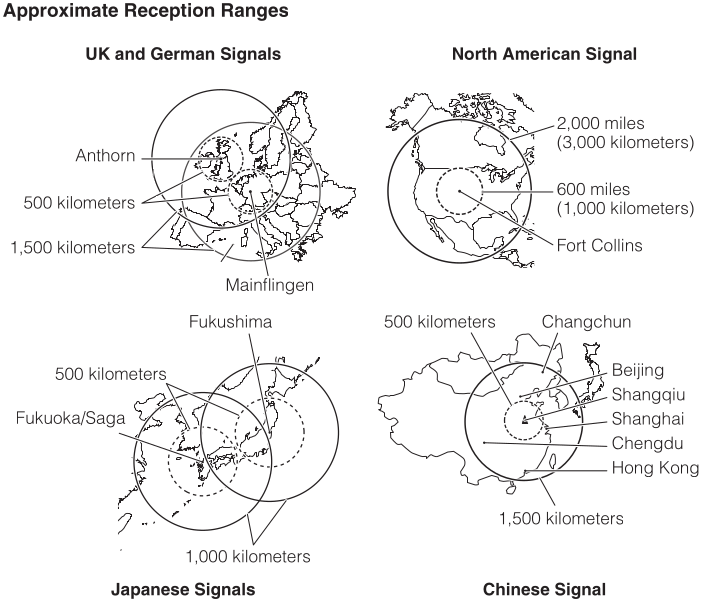
Those watches listen for up to 6 distinct time radio signals: 2 in Japan, 2 in Europe, and one of each in China and the United States. Each station uses a different frequency ranging from 40kHz for the one in Fukushima, to 77.5kHz for the one in Germany. Spreading the supported radio signals over the globe allows those watches to keep in sync with the global time over a big part of the world.
Combining this functionality with a solar powered source, we have finally achieved a portable self-sustained device which accurately keeps track of time without maintenance or intervention. What a time to be alive.
time’s up
We have come a long way since Johnny the Neanderthal’s conundrum. Countless innovations provided each a small piece of the puzzle until time-keeping was no longer a hurdle. Lately, the rise of the smartphone has seen watches being phased out or grow into novelty items as new technologies build on the availability of easily accessible time information.
Perhaps the future holds more steps in the evolution of time-keeping, whether that will be watches running on atomic power, or hybrid devices transmitting the time directly to our thoughts.
Or perhaps we discover that keeping track of time with such precision is not beneficial to our human minds and bodies, and we decide to resume a more care-free lifestyle where doing things in a more relaxed schedule is not the end of the world. Only time will tell.